
The black bear and the grizzly

Updated: Jun 18
In 1985, I was a graduate student at the University of Connecticut.
At the time, psychology interested me, but I had not yet fully realized the path that would eventually shape my life.
That summer, a few friends and I decided to ride our motorcycles from Connecticut to Acadia National Park in Maine for a camping and hiking trip. We wanted to hike Cadillac Mountain and take a break from our studies. We were young, broke, and looking for adventure.
One afternoon, while wandering through town, we stopped at a small boutique filled with Native American art, jewelry, and handmade crafts.

As I walked through the door, a woman standing across the room pointed directly at me.
"Bear," she said.
I looked behind me to see who she was talking to.
"B-E-A-R," she spelled it out.
I was twenty four years old and had no idea what she meant. I ignored her and continued toward the opposite side of the one room shop.
A few minutes later she approached me again.
"Do you know how bears fit into your life?" she asked.
I told her they didn't.
The only connection I could think of was my brother, who suffered from chronic schizophrenia. One day he announced that he was going to hunt black bear in Maine while carrying a desk on his back down the stairs of my parents' house, sporting a freshly shaved head.
The only other connection I could think of was a book I had read called Black Elk Speaks, which contained references to bears, but nothing that seemed particularly significant.
She listened carefully.
"I know what that means," she said.
At this point, I was thoroughly confused.
She then took me by the hand and led me into the back room of the shop where she apparently lived. Hanging above her bed was a large painting of a bear.
She pointed to it.
"This is a black bear," she said. "Black bears are healers."
Then she looked me directly in the eye.
"You are a black bear who stands on his hind legs in order to see better."
Then she paused.
"But you must be careful because you also have some grizzly bear in you. If you're not careful, you will hurt more people than you heal."
I remember standing there wondering what in the world she was talking about.
At the time, I was studying Educational Psychology at UConn and working part time on an adolescent crisis unit at a local psychiatric hospital. I enjoyed working with kids and knew I was pretty good at it, but I had never thought of myself as a healer.
Not really.
The conversation stayed with me, but what happened next made an even bigger impression.
As my friends shopped, Tamiki explained the significance of porcupine necklaces they were purchasing. According to her, the quills protected the wearer by intercepting negative energy, bad spirits, or ill intentions before they could cause harm.
I wasn't shopping.
I had no money.
My friend John eventually asked me what I would buy if money weren't an issue.
I looked around the store and finally pointed to a necklace inside a display case.
Immediately, Tamiki rushed over.
"See?" she said. "You are a black bear."
The necklace contained a single black bear claw surrounded by wood and bone beads.
I told her I couldn't afford it.
Without hesitation, she removed it from the display and placed it around my neck.
Then she turned me around and asked, "You live by yourself, right?"
I remember wondering how she knew that.
"Yes," I replied.
"I'm giving this to you," she said. "I only want one thing."
"Your address."
"Why?" I asked.
"I like to know where my black bears are."
Before we left, she handed me what she called sacred grass. I don't remember whether it was sage or sweetgrass, but she told me to burn it in my apartment because it would purify my space and the air I breathed.
By then, I was ready to leave.
Part of me thought the whole experience was fascinating.
Another part of me was deeply uncomfortable.
That night, on our ride back to Connecticut, John and I stopped to camp because the motorcycle ride was too long to complete in one day.
As we sat around the campfire trying to make sense of everything that had happened, John told me that Tamiki reminded him of a woman he once knew who many people considered a witch. He had apparently been trying unsuccessfully to reconnect with her.
We talked late into the evening about what Tamiki might have meant.
Neither of us had any answers.
Two weeks later, a package arrived.
Inside were the porcupine necklaces my friends had purchased.
There was also a note.
It contained only a few words.
"Tell the bear that he has come through many times and that he is good."
I still don't know exactly what she meant.
For the next several years, I wore that bear claw necklace every day.
Through graduate school.
Through the beginning of a career devoted to helping young people and families navigate suffering, uncertainty, and change.
Then one day, it disappeared.
I was devastated.
The necklace had become more than jewelry.
It had become part of my identity.
Years later, while visiting my hometown, I found myself telling the story to another Native American shop owner who had opened a small store near my old neighborhood.
After listening carefully, she smiled.
"It's obvious what happened."
"What?"
"The necklace hopped off your neck and went back to the person whose vision it was made in."
I laughed.
Then she said something I never forgot.
"Your problem is that you need to make a necklace in your own vision."
As far out as that sounded, I took it to heart.
Several years later, while traveling through New York on my way to the twenty fifth anniversary of Woodstock, I walked into another shop and immediately spotted a single bear claw hanging around the neck of a carved Native American chief.
I bought it on the spot.
When I returned home, I gathered materials from the woods and built my own necklace.
This time it wasn't Tamiki's vision.
It was mine.
I wore that necklace for years as my life unfolded.
I finished graduate school.
Built treatment programs.
Worked with children and families in crisis.
Helped people navigate mental health challenges, adoption journeys, leadership struggles, and organizational change.
Eventually, as time began taking its toll on the necklace, I passed it on to my oldest son, Holland.
Then once again, it disappeared.
Or so I thought.
Years later, my children suggested we all get tattoos together for Father's Day.
Like many family plans, enthusiasm exceeded execution.
Everyone backed out except my wife, Belinda.
That afternoon, while riding our motorcycle through Deep River, Connecticut, we stopped at a local tattoo studio.
Neither of us found anything we particularly liked.
Before we left, the artist asked what I would get if I ever decided to get a tattoo done.
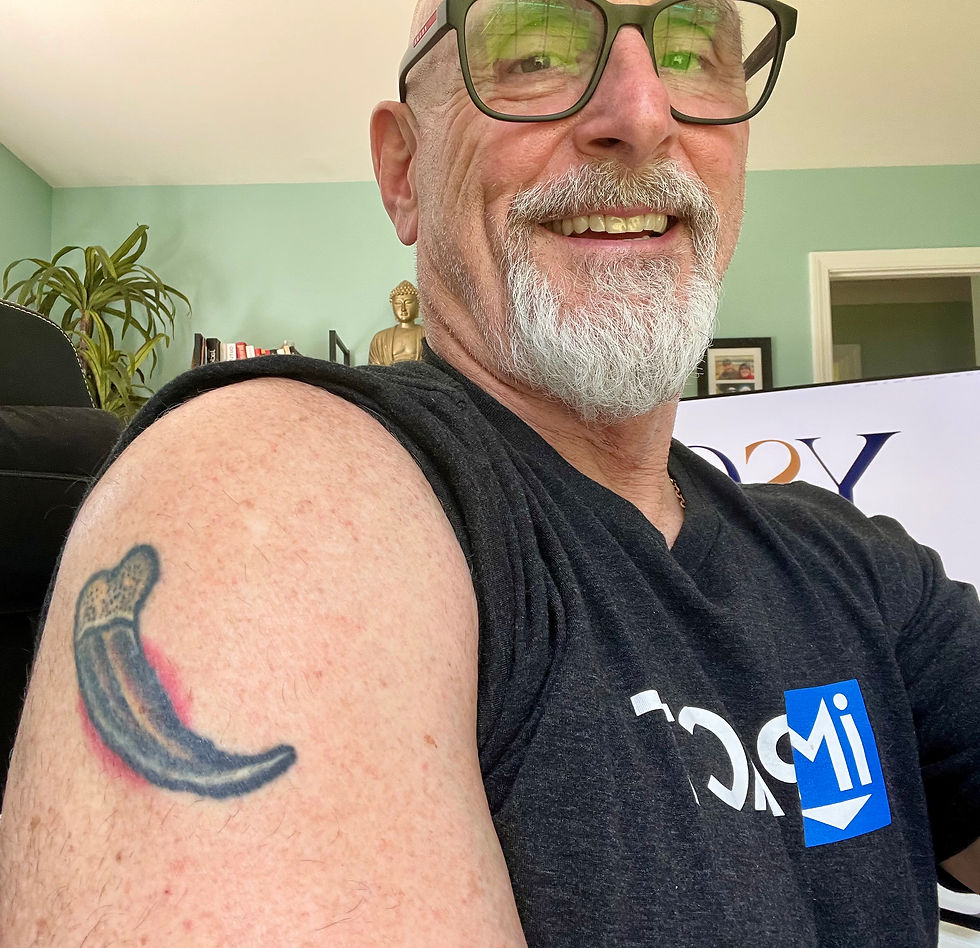
"A single bear claw," I replied.
The problem was that all the bear tattoos I had seen featured an entire paw. Five claws.
That wasn't what I wanted.
The artist disappeared into the back room.
A few minutes later he returned holding a sketch.
It was perfect.
Exactly the bear claw I remembered.
As he tattooed it onto my shoulder, he asked me why I wanted a bear claw.
I told him the story of Tamiki.
Halfway through, another artist working several stations away interrupted.
"Are you talking about Tamiki from Bar Harbor, Maine?"
"The woman who assigns spirit animals?" he asked.
I nearly fell out of the chair.
More than twenty years had passed.
Hundreds of miles separated us from that little shop.
Yet somehow this stranger in Connecticut knew exactly who I was talking about.
What are the odds?
The bear claw became permanent that day.
Not because I needed a symbol.
But because I had finally integrated what it represented.
Today, decades later, both bear claws have somehow found their way back to me.
They sit on my desk as I write this.
After all these years, I still don't know exactly what Tamiki saw in that little shop in Bar Harbor.
Maybe she saw something mystical.
Maybe she saw something psychological.
Maybe she simply saw something in me that I could not yet see in myself.
What I know is this.
The older I get, the more I think she was right about both bears.
The black bear is the part of me that heals, teaches, guides, and protects.
The grizzly is the part that fights, pushes, challenges, and sometimes wounds.
Over the years, I have seen both.
The black bear showed up in hospitals, classrooms, treatment programs, coaching conversations, and countless opportunities to help people find their footing.
The grizzly showed up too.
In moments of impatience.
In convictions held too tightly.
In boundaries crossed.
In people I unintentionally wounded along the way.
Most of my life has been spent trying to do good in the world.
But age has taught me that both bears live inside me. The Black Bear and the grizzly.
Perhaps inside all of us.
Wisdom does not come from pretending one of them doesn't exist.
It comes from recognizing which one is in the room.
Years later, while reading about Native interpretations of the black bear, I learned that a bear standing on its hind legs is not necessarily preparing to fight. More often, it is trying to see better. It rises above the brush to gather information, gain perspective, and understand what lies ahead before moving forward.
That realization struck me.
At the time I met Tamiki, I was searching for answers about my own identity. I had recently completed a search for my birth mother and was trying to understand where I came from and who I was becoming.
Looking back, perhaps that is what she saw.
Not a healer.
Not a psychologist.
Not an executive coach.
Just a young man standing on his hind legs trying to see better.
For more than forty years, that lesson has followed me.
The black bear still shows up.
So does the grizzly.
Age has not eliminated either one.
It has simply helped me recognize which one is in the room.
And forty years later, I still find myself standing on my hind legs, trying to see better.


Comments